Technology Policy - India
India AI Impact Summit Outputs and Outcomes
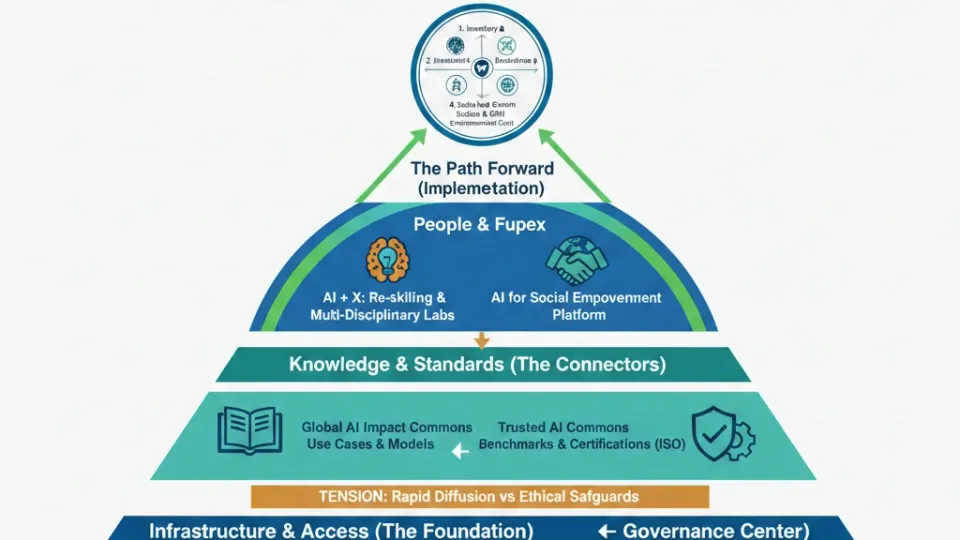
India AI Impact Summit Outputs and Outcomes
After an impactful AI Summit, it’s time to reflect on the outcomes and pave the path forward. New Delhi declarationyarn dev appears to be built and expanded on the releases of AI governance Guidelines, and the two white papers - Democratising Access of AI Infrastructure and Strengthening AI Governance Through Techno-Legal Framework. The deliverables announced in the declaration - developing AI commons with case studies, open access to resources, AI skilling are promising ones which will encourage rapid diffusion of AI, with voluntary guidelines on safety and trusted AI systems. For those who wished to see mention of sovereign AI in the declaration, this is a wakeup call. The declaration asserts that safe AI adoption is possible even when we don’t have stringent regulations and total control over the AI stack. The technology is too big for any single entity (be it the government or private) to control, and it is natural to let the market play its fair game while individual users will also bear some responsibility for how they adopt and use these systems. While this is said, governments cannot be irresponsible and abdicate their responsibilities to protect the rights of the citizens. However, for now, let’s look at the key takeaways from the declaration and map it with the existing products on AI governance and ask relevant questions and evaluate the path forward.
Charter on Democratic Diffusion of AI
“A voluntary and non-binding framework to promote access to foundational AI resources, support locally relevant innovation, and strengthen resilient AI ecosystems while respecting national laws.” What does democratic diffusion mean? As per the white paper titled “Democratising Access to AI Infrastructure” - Democratising access to AI infrastructure means making the AI infrastructure - compute, datasets and model ecosystem available and affordable, such that it reaches a wide set of users. Anchoring on this definition, Democratic Diffusion of AI would mean making the models easily accessible to the global demand. Here it is important to understand the relationship between the private companies and the government. If the government is spearheading the AI adoption, it is important to classify the benefactors and analyse if this paves a path for AI companies to become globally dominant players. The phrase - ‘Strengthen resilient AI ecosystems while respecting national laws’ appears to accept AI ecosystems to be global. I think AI ecosystems are mix of national and international supply chains. Telecom, broadband, satellite communications, internet, output-based regulations of AI fall within the national jurisdiction and control. However, the subsea cables transferring data across continents, data transfers between the countries, semiconductor supply chain, cloud services are transnational. In this scenario, more clarity is required from the deliverable advocated in the declaration.
Global AI Impact Commons
“A voluntary initiative that provides a practical platform to encourage and enable adoption, replication, and scale-up of successful AI use cases across regions.” There are already platforms which hosts open-source AI models which are successfully tested on the training datasets. One such example is Hugging face. It is a repository of AI models, datasets, technical documentation, which are freely available. In addition to this, one could find AI models on GitHub. While such platforms are available, creating AI Impact Commons, would possibly refer to the compendium of use cases along with the relevant AI models made available for public usage. During the AI Impact Summit, India already released use-cases of AI, and the next step would be to add the models used in each of the use-case and deploy it on the GitHub or Hugging face. Making this a global initiative should also not be a problem since 91 countries have already signed this declaration. All the countries that are signatories could upload their use cases + AI models making it a global repository of proven models. However, the challenge is that some of the use cases are pilots for AI companies. In this case, the challenge will be to open-source the AI model, that is attached to the use-cases. If only use-cases are highlighted, then perhaps, this needs to become a repository of risk, and impact analysis.
Trusted AI Commons
“Voluntary and non-binding Trusted AI Commons, a collaborative platform consolidating technical resources, tools, benchmarks and best practices that all can access and adapt to their contexts; as well as its voluntary guidance note”
To implement this, we must develop a framework that reviews the global AI models against a set (but dynamic) metrics that measure the trusted AI ecosystems - including technical benchmarks, techno-legal solutions upholding privacy and data protection, content provenance tools, ethical AI certifications, ISO 42001/05 certifications.
International Network of AI for Science Institutions
“A collaborative platform to connect scientific communities and pool AI research capabilities across regions among participating institutions, in order to accelerate the impactful adoption of AI”
Multi-disciplinary research labs on AI encouraging exchange programs among the signatories should be initiated with a focus on long term research gains. AI development though might be the dominant economic opportunity right now offering jobs world-wide, but it is the multi-disciplinary labs that will encourage AI diffusion.
Focus should be on encouraging AI + X (subject) talent where the diffusion on AI should take the precedent. The necessity of funding for AI development, tagging with the multi-disciplinary research areas is echoed in Carnegie’s 2025 report “The Missing Pieces of India’s AI Puzzle” which analyses government and private R&D spending in India and also Pacta’s report on “AI adoption in India’s Social Sector Programs” which is a comprehensive research on how AI is used in India’s development sector.
AI for Social Empowerment Platform
“A collaborative platform to facilitate exchange of learning, knowledge, and scalable, practices to advance AI adoption or social empowerment.”
Ideally, this should look like a Gitbook with a section dedicated to call for expression of interest, call for books, request for proposals and another section dedicated to Mission Karma Yogi Bharat with AI sessions access.
AI Workforce Development Playbook and Re-Skilling Principles
“Voluntary guiding principles or re-skilling the age of AI and e playbook on AI workforce development, which would support participants in preparation for a future AI driven economy.”
Why are these maintained as separate platforms when integration would serve both goals more efficiently? I believe they are complementary and a common platform incorporating the both should be developed.
Guiding Principles on Resilient & Efficient AI
“Voluntary guiding principles on resilient, innovative, and efficient AI would guide us towards the development of resilient and efficient AI systems. We also take note of the playbook on advancing resilient AI infrastructure as a knowledge output, which is a reference source to support resilient AI development.”
Resilience in AI infrastructure starts from the recognition that AI is the foundation for the socio-economic activities. In such scenario, the question of how much basic AI is considered should be answered by the states. Is it like electricity? Roads? Or are we going to make the same mistake as we made with the telecom industry and internet? Who has the ultimate say when these digital systems become fundamentals of the society? To answer these questions, an anticipatory AI governance center should be established with funds being contributed by the signatories. If not, India should start the “AI Anticipatory Governance Center” and initiate partnerships with other countries.
When it comes to sustainability, increasing AI investments across its value chain from critical minerals, network infrastructure, semiconductors, electronic devices and components, data centers, and the software stack also results in adverse impact on the environment. The rapid growth of energy demand forces countries to lean towards fossil fuel-based power generation derailing the climate change mitigation initiatives. Thus, the guiding principles should also include a component of sustainability.
The New Delhi Declaration is a significant diplomatic achievement with 91 countries signed the declaration on a voluntary framework for AI governance is not a small feat. But the real test lies in implementation. The Impact Summit should not be a one-time international event. Voluntary frameworks, however well-intentioned, risk becoming repositories of good intentions unless backed by institutional accountability, sustained funding, and political will. The deliverables announced including AI Commons, skilling platforms, trusted AI benchmarks, and science networks are the right building blocks. What is missing is a clear architecture that connects them, a mechanism that tracks progress, and an honest reckoning with the tensions the declaration leaves unresolved: between global AI ecosystems and national sovereignty, between rapid AI diffusion and environmental sustainability, and between market-led adoption and the state’s obligation to protect its citizens.
If India takes the lead in establishing a team to enable these deliverables under the GPAI and drives the operationalization of these commitments, the New Delhi Declaration could mark the beginning of a genuinely inclusive global AI order. If it remains a statement of intent, it will join a long list of well-worded declarations that the technology outpaced.