Technology Policy - India
Who Should Control the Cybernetic Social System?

Who Should Control the Cybernetic Social System?
What is a Cybernetic Social System, and who should control it? The term refers to how societal feedback loops train algorithms that, in turn, nudge public behaviour in specific directions. Now that most of the societal interactions are wholly or partly dependent on the internet, entities that control the cyber systems will impact the thinking and communication of people. In this scenario, the most impacted will be the freedom of speech.
In an article published on September 17, 2025, in Mint, Mr. Rahul Matthan, partner at the law firm Trilegal, argues that such cybernetic social systems should be controlled by elected representatives rather than left in the hands of private companies.
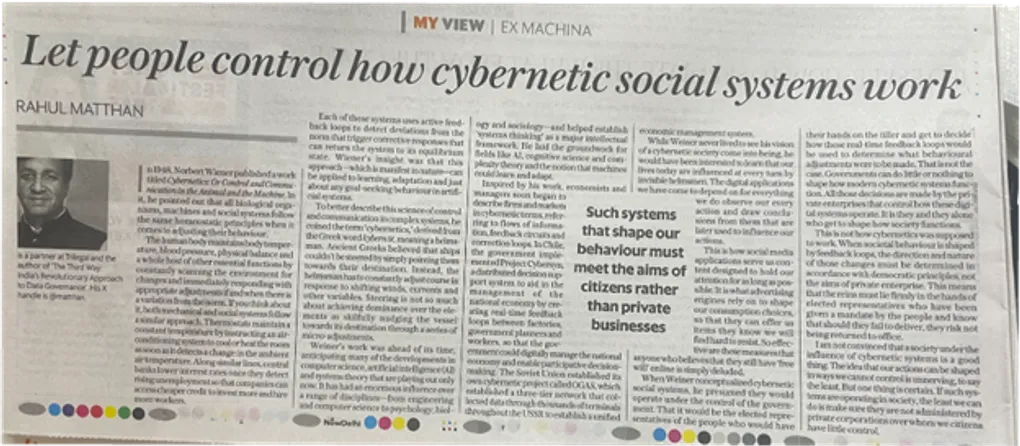
Matthan rightly raises concerns about excessive private control over internet-based communication. He points out how private digital platforms influence individual decision-making, asserting that “it is they alone who get to shape how society functions.” Indeed, algorithms operate to maximize user engagement with profit motives in mind. However, governments worldwide are responding by enacting laws on data protection, data portability, and digital sovereignty.
For instance, the European Union’s General Data Protection Regulation (GDPR), enacted in 2018, enforces strict privacy protections. The EU’s AI Act regulates AI systems, banning those that pose high risks. China has introduced the Personal Information Protection Law (PIPL) and guidelines for Algorithmic Recommendation Systems, which govern how platforms like search engines and TikTok engage users. On digital sovereignty, India’s recent agreement with the Philippines to export TCS Sovereign Cloud systems enables the Philippines to control its digital information flows territorially. This demonstrates that states are no longer mere bystanders but active participants in managing the cybernetic social system.
Currently: Both Private and the State are trying to control the Cybernetic Social System
While elected representatives should have a voice in governance, I disagree with Matthan’s argument and believe that giving elected officials unchecked control over digital information infrastructure is fraught with risks. As Norbert Wiener, the pioneer of cybernetics, foresaw, the flow and control of information are critical national infrastructure. Ronald Deibert, Director of Citizen Lab, reveals in his book Chasing Shadows how states, whether authoritarian or democratic, routinely use cyber tools for pervasive surveillance and control.
Elected representatives, motivated by power, may exploit societal divisions using control over cybernetic systems, threatening democratic values. The risk of misuse for political gain is significant, as widely demonstrated in the manipulation of public discourse and social media dynamics. Neither state nor private entities alone have a fully trustworthy claim to oversee this realm.
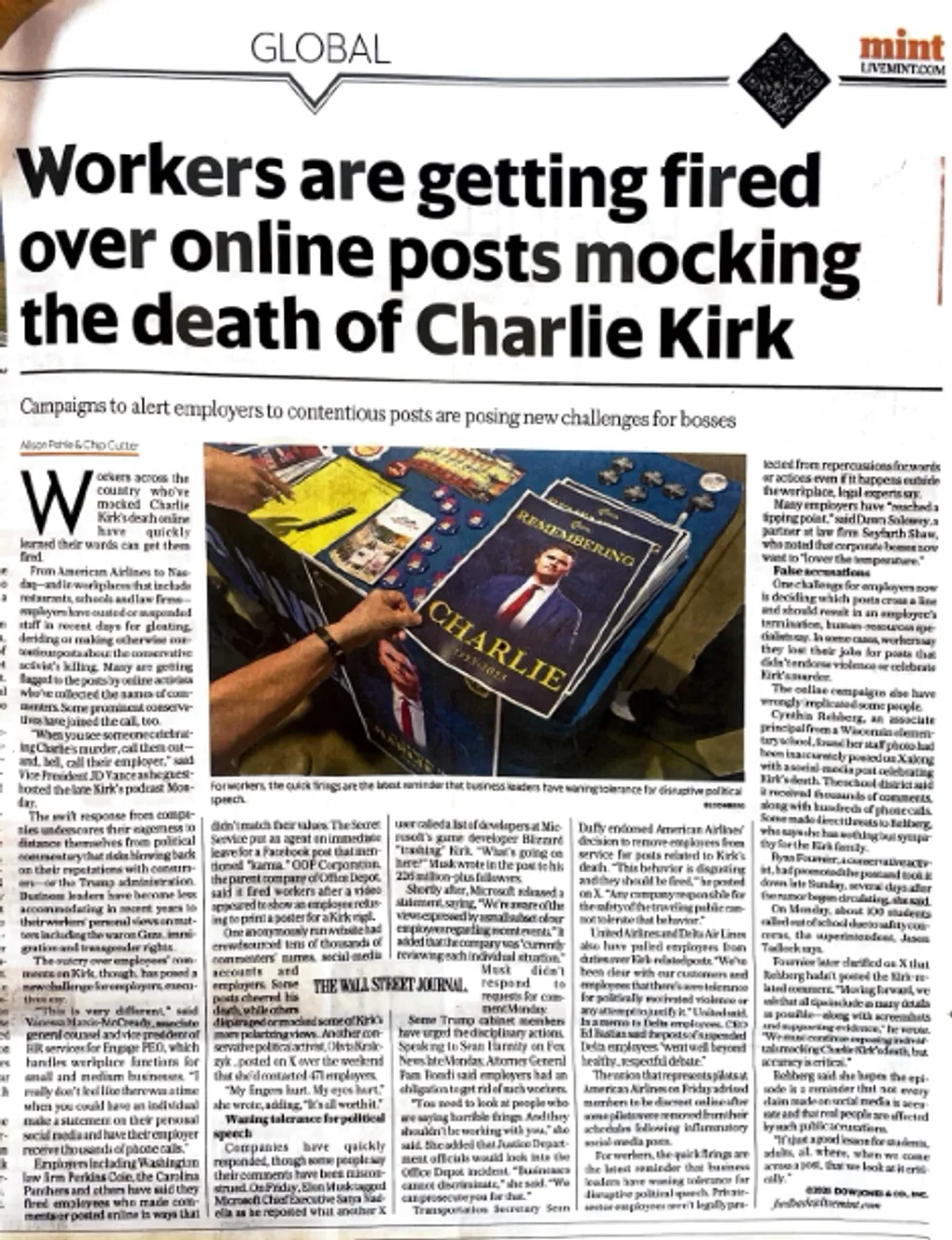
The same issue of Mint that featured Matthan’s piece also reported instances of corporate cyberspace overreach, suggesting that neither the public sector nor the corporate sector is suited to govern public digital communication. One of the examples Mint provided was the termination of several people in the U.S. who made jokes online about the death of Charlie Kirk, a right-wing political activist who was assassinated in September 2025. The article noted that Microsoft CEO Satya Nadella flagged posts criticising Kirk and assured that each individual situation is being reviewed. There is no information on whether Microsoft terminated the employees who favored violence against Charlie Kirk.
Seperately, in an interview with Fox News, U.S. Attorney General, Pam Bondi, affirmed that this kind of employer surveillance was justified and that employers have a responsibility to act upon such information. Of course, an open support of murder is unacceptable, but from the article published by Politico, suggests that the department of Justice (DOJ) is setting up a precedent rallying on the political party’s agenda. This kind of cyber surveillance, perhaps with a backing of federal governments or even a legislation risks curbing free expression in favour of certain viewpoints or political agendas.
Please click on the link provided in the earlier paragraph since the image is not clear
Need for an Independent, Technically Expert Body
If neither private companies nor elected leaders are effective in protecting the democratic values including the individual liberties, who should be responsible for protecting freedom of speech in the digital age? The solution lies in a third way- boundary conditions for cyberspace that must be established not by a government ministry, but by an independent, technically expert body. This body’s mandate should be to govern the cyber space dynamically, with its decisions subject to scrutiny by the courts, and civil society organisations, acting as crucial check on its power.
This is not a radical idea. India already delegates complex, sensitive matters to independent authorities to ensure stability and fairness. India’s SEBI, RBI, and TRAI are some examples. The integrity of our information ecosystem, the very foundation of modern society, deserves no less. It is time to stop choosing between the state or private company, and to build a system that is truly accountable to the public it serves.